Showing posts with label Spirituality. Show all posts

Sunday, 7 July 2013

Kitsch Jesus in the Smelly City

Back in the day I posted a blog about meeting God on Market Street in Manchester. That encounter prompted me to develop some material on Urban Spirituality for our MA course on Spirituality in Contemporary Culture.  This in turn spawned a framework for a half-day city centre retreat which has been taken up by friends and students for use in Prague, Stockholm and Birmingham.

This week here at Luther King House we've been teaching the Spirituality module on our MA Summer School.  We ran the city centre retreat again.  It got lots of positive feedback from the students.  It also gifted me with another unexpected encounter with Jesus.

I wasn't actually doing the retreat myself this time but I was in the city, buying bread and wine for the communion on the street that would round off the day.  I was making my way through the Northern Quarter on my way to Methodist Central Hall for our retreat debrief when God's Spirit beckoned me into a seedy night club back entrance.  I like to use back streets whenever I can.  It makes walking more of an adventure.  I'm not sure what The Spirit used to grab my attention, in fact I haven't a clue, but I found myself walking over to take a peek.


And there, in a stinking, piss-soaked door-well was Jesus.  (Apologies if the word piss upsets you, I don't mean to offend, it's just that neither wee nor urine are quite up to the job.)


I realise this is a rather kitsch Jesus, but I was in the Northern Quarter where they do kitsch rather well.  So it sort of fit.  It also fit because it seems to me it's just the kind of place you'd expect to see Jesus.  Or at least the kind of place where you ought to expect him.   How fitting too that he'd been defaced.  They'd scrubbed out the word love.  Or at least they'd tried to.  True the letters had been erased but the word's still there don't you think?  Again, it's the only word that really fits.

... he had no form or majesty that we should look at him, nothing in his appearance that we should desire him. He was despised and rejected by others; a man of suffering and acquainted with infirmity; and as one from whom others hide their faces he was despised, and we held him of no account.
Surely he has borne our infirmities and carried our diseases; yet we accounted him stricken, struck down by God, and afflicted. But he was wounded for our transgressions, crushed for our iniquities; upon him was the punishment that made us whole, and by his bruises we are healed.
Lord, we pray for all who use that door-way.  And we pray for ourselves. Please beckon us into uninviting places.  Meet us there and open our eyes.  And if need be our nostrils.  Amen

Wednesday, 12 June 2013

Exploring Contemporary Spirituality - Theology Summer School at Luther King House

This is coming up soon.  Places are filling up quickly.  Still a few slots left.  To book by email click here learning@lkh.co.uk


Monday, 8 April 2013

LKH Summer School, Exploring Contemporary Spirituality

Just out, details of this year's Luther King House Summer School.  This will be the third time we've run this as a Summer School.  It always goes down well.  Why not join us?  Spread the word.


Wednesday, 2 May 2012

Believing in Belonging: Belief and Social Identity in The Modern World


Day, A. (2011). Believing in Belonging: Belief and Social Identity in The Modern World.  Oxford: Oxford University Press


This fascinating monograph explores the nature of believing in modern Euro-American societies.  It is based on the author’s post-doctoral research at Lancaster University and builds on her PhD thesis, a case study centred on the Yorkshire town of Skipton.

Day set herself the challenge of exploring belief by asking open questions that did not presuppose that answers would be offered in relation to religious categories.  So, for example, What do you believe in? and, What or who is most important to you in your life?  She then compared her findings with related studies from around the world.  The research is well designed and the results significant.

The main finding is summed up in the title: people believe in belonging.  To say they believe is to engage in identity building by claiming belonging – to Christianity (even if they don’t believe in God) to family (on condition that they get to decide who qualifies as family) and to friends (with whom they work out their problems and their opinions).

Unsurprisingly then Day suggests that Grace Davie’s influential argument that people in Britain today believe but don’t like to belong misses the mark.  People may not choose to participate in the activities of organised, institutional religion but this does not mean that belonging is unimportant.  On the contrary, for most people believing is profoundly relational.  People believe because they belong and in order to reinforce belonging.

This believing in belonging is found to apply to those (the great majority) for whom believing is anthropocentric, that is those who articulate their beliefs primarily in reference to their human relationships.  It also applies to those for whom believing is theocentric in that they cite God and their relationship with God as central to their lives.  This observation leads to an interesting and nuanced exploration of the phenomenon of Christian nominalism.

Day offers us a rich picture of what it is to believe and in the light of her research suggests that we consider seven dimensions of the phenomenon: content, what people believe; sources, where beliefs originate; practice, whether and how belief informs behavior; salience, the importance people attribute to their beliefs; function, the role of beliefs in people’s lives; place the relationship between belief and location whether public or private, geographic or social and time, the fluidity or fixity of beliefs in relation to passing time and specific times.  As an interpretive framework this scheme would seem to have real potential.

Much more could be said about what this book has to offer; there is a Foucault inspired archeology of the concept of belief in the fields of  sociology and anthropology; there are interesting observations on the way people limit moral obligations to those to whom they belong and the significance for many of ongoing relationships with the dead; there’s an investigation of young people and belief, of believing in fate and of the “othering” of women, non-Christian religions and “Asians” as those responsible for moral decline.  All this in two hundred pages.

I have long thought that missiologists don’t pay nearly enough careful attention to the work of sociologists of religion – Duncan McLaren’s Mission Implausible was a notable exception, now sadly out of print.  Abby Day writes as an academic sociologist and an active researcher.  Her findings are a helpful contribution to the sociology of secularisation; they open an intriguing window into believing in Britain today.  Believing in Belonging makes instructive reading, to say the least for those us concerned that our compatriots might come to belong to the company of those who believe in Jesus.

This review was originally written for Regent's Reviews and is reproduced here with permission of the editor.  Check out the web site to get a free pdf of a whole bunch of reviews. 

Friday, 20 April 2012

The Longing For Home - Review

Buechner Frederick, The Longing For Home, Harper Collins, 1996, 180pp.

I've decided to stick a few book reviews up on the blog.  Some of them were written a while ago.  
 
The Longing For Home is the kind of Christian book that only America seems to produce.  Would that we had an Annie Dillard or a Eugene Peterson. 

If I tell you that this is a collection of essays, meditations, poems and mini, sermon-type, reflections, it will probably put you off.  Don’t let it, please.  This is a book to do your soul good.  Deeply personal and acutely spiritual, it will move your heart and open your eyes.

The Author, Frederick Buechner (pronounced Beekner), is a Presbyterian Minister in his 70’s.  Taking as his theme the concept of home, the home that we remember and the home to which we are heading, he explores issues of family relationships, the inner-connections of community life, death, birth, the spirituality of creation, grace, hope, faith and love. 

Inevitably with such a collection some pieces have more merit than others but the overall standard is very high.  At times you can detect the odd bit of desperate editorial work to make previously existing, independent pieces fit into the theme but that’s the most minor of irritations.

I read the book in two sittings while on holiday.  I plan to read it again - for the sake of my soul.

Thursday, 20 October 2011

Music and Spirituality

Been preparing for a session that I'm teaching in a week or two on our MA module "Contemporary Spirituality".  Came across this from Don Salliers in Minding The Spirit Elizabeth Dreyer and Mark Burrows (eds.)
Music itself … offers us a pattern of how we actually experience the world and our lives.  It presents to us a morphology of human existence.  … I propose that spirituality has to do with sounding life before God.  Because we live through time music is perhaps our most natural medium for coming to terms with time and attending to the transcendent elements in making sense of our temporality.  Our lives, like music, have pitch, tempo, tone, release, dissonance, harmonic convergence, as we move through times of grief, delight, hope, anger and joy.  In short music has this deep affinity to our spiritual temperament and desire.  Our lives like music can only be understood in remembering the passage through time.  The order of sound is comprehended as we remember and reconfigure the previously heard in light of the yet to be heard.  So, too, the deeper desires and yearning of the human soul are not understood until a larger pattern emerges.
I liked it so I thought I'd share it.  Hope you like it too.

Saturday, 20 November 2010

This is what I'm going to be doing on Saturday.  I know I've told you already.  Thought I'd tell you again though cos if you are planning on joining us you really ought to book in by Wednesday.

Monday, 15 November 2010

Manchester City Centre Spirit Walk

Those who've been following my stuff on City Centre retreating might be interested in this from Ben Edson.

Friday, 5 November 2010

Retreat Cineman Retreat Cinema Retreat Cineman Retreat Cinema

OK I admit it, some of these Outside Edge columns have failed to persuade my readers.  When I suggested that watching 18 certificate films is good for us it quickly became apparent that some of you see things differently.  When I advocated city-centre retreats as a much needed alternative to seeking God in the rural not everyone was convinced. 

What’s a man to do?  I know!  Why not combine the two ideas?  This week, dear reader, I would like to suggest that watching films is a great form of retreat.  Forget drafty prayer cells, knock those expensive Laura Ashley-fied country house conference centres on the head; head instead for the multiplex.

This the place to step out of your routine.  This is the place where time runs differently.  This is the place to switch off and tune in.  This is the place to immerse yourself in big ideas.  This is the place to learn to see things from a whole new perspective.

Here’s the deal: in exchange for seven quid you get three hours away from it all, alone with others in the dark and the chance to contemplate issues of beauty, morality, truth and character.  And, if my experience is anything to go by, you may well find yourself bumping into God.  All this and popcorn too!  Can’t be bad.

If you are tempted to object that clearly it can be bad, that film often plunges us into the dark side, then dear reader, I have to reply that you seem to have a limited knowledge and a shallow experience of retreating.  To retreat is often to confront darkness, the darkness of our world and the darkness of our own soul.

If you are tempted to object that what I describe is not retreat but escapism, then dear reader, I have to reply that these are very closely related.  Retreating begins by escaping.  What’s important is that it doesn’t end there.  To retreat is to escape from busyness and routine so as to attend to God, God’s world and our own inner life; to attend to these things that we might gain insight, grow in wisdom, and then re-engage the every day - fresher, deeper.

I recently lead a church away day.  We talked a lot (or at least I did), we sang, we prayed.  It was good.  But for those of us who chose not to spend the afternoon shopping, walking or playing football the most potent part of the day was watching the film, Whale Rider, a moving exploration of identity, spirituality, tradition, renewal and the survival of a distinctive way of life in the face of an indifferent society.  We cried.  We were uplifted.

Consider this too dear reader, even if you are not persuaded by my impeccable logic and subtle rhetoric it seems that many millions of others are.  According to a recent survey in America over twenty percent of the population now turn to media, arts and culture as their primary means of spiritual experience and expression. 

Cinema is a foundry of world views, a forging place of  moral opinion and spiritual perspective, it is a potent expression of the creativity with which the Creator imbues creatures.  It is an arena where the spirituality of inherently spiritual humanity bubbles to the surface and pops right in your face.  And no, of course, it’s not all Godly but neither is it Godless.  The Spirit wafts across these sometimes dark, chaotic waters and hatches life.  But only those who take the time, only those who look and listen, will notice.

(To explore these ideas further read Craig Detweiler’s Into the Dark or Robert Johnston's Reel Spirituality both published by Baker - you can go get them by clicking over there on the right, in the sidebar, the Stuff I Reccomend bit.)

My turn to do a month's worth of opinion pieces for the Baptist Times' "Outside Edge" column has come round again. With the agreement of the editor I'm posting my BT article here. To check out the Baptist Times as a whole click here.

Friday, 22 October 2010

God At The Movies?

More shameless self publicity.  This is one of our Luther King House Church Saturdays.  I think the flyer's self explanatory.  If you're in the Manchester area, why not come and join us?  Click on the image below to mail us with your booking.

Friday, 16 July 2010

Piccadilly Gardens and Christ the Windhover

While I'm going on about urban retreats I thought I'd share this with you.  The week before our little experiment I was chatting with my daughter about the idea of seeking the presence of God in the City.  She got a bit excited.  She reached into her bag and pulled out her sketch book to show me the picture that accompanies this post.

It's a quick sketch she'd done a few weeks earlier while she was in Piccadilly Gardens in the heart of Manchester when everything went "quiet".  A police helicopter was hovering right over the gardens.  Everything stopped.  Everyone looked up.  Including her.  She noticed that the helicopter was kind of cruciform, so, as she is wont to do, she scribbled down a quick sketch to catch the image.

What my daughter didn't know was that there's a Christian tradition of seeing the Kestrel as an image of Christ.  Another cruciform hoverer on high.  To accompany the sketch here's Gerard Manley Hopkins' poem The Windhover.

To Christ our Lord

I caught this morning morning’s minion, king-
dom of daylight’s dauphin, dapple-dawn-drawn Falcon, in his riding
Of the rolling level underneath him steady air, and striding
High there, how he rung upon the rein of a wimpling wing
In his ecstasy! then off, off forth on swing,
As a skate’s heel sweeps smooth on a bow-bend: the hurl and gliding
Rebuffed the big wind. My heart in hiding
Stirred for a bird,—the achieve of, the mastery of the thing!

Brute beauty and valour and act, oh, air, pride, plume, here
Buckle! AND the fire that breaks from thee then, a billion
Times told lovelier, more dangerous, O my chevalier!

No wonder of it: sheer plod makes plough down sillion
Shine, and blue-bleak embers, ah my dear,
Fall, gall themselves, and gash gold-vermillion.

Thursday, 15 July 2010

City Centre Retreat

I posted recently about an encounter with God in the heart of Manchester city centre.  The experience prompted me to suggest that it would be good if we put a bit of effort into encouraging organising and resourcing urban retreats.  For once instead of just shooting off my mouth I did something about it.  Last week as part of our Summer School at Luther King House I taught a session on Urban Spirituality and I organised an afternoon's city centre retreat.  Not much I know but hopefully a beginning.  Here's an extract from the introductory hand-out.

This afternoon’s field trip is an experiment in urban spirituality.  You will spend  a couple of hours in Manchester city centre following a particular spiritual exercise.  The aim is to see if and how the urban setting might become a doorway to spiritual insight.

At the heart of each of the exercises is the need to attend, in other words to became aware by giving yourself to a particular aspect of life in the city.  The art of attending is a core element of classic spirituality.  This applies whether we are thinking of one of the Christian spiritual traditions, the traditions of other faiths, or more broadly spirituality by way of aesthetic experience.

To discern we must attend, give ourselves to the object of our attention.  The question that you will each be asked to carry with you at all times throughout the experiment is, “What am I experiencing?”

In other words the retreat was essentially an exercise in meditation.  We sought to attend to various aspects of city-centre life - the artefacts, the built environment, the people.  Judging by the feedback most of the participants appreciated it.

I'm blogging about this as a way of offering the resources that I developed for the retreat to any who might be interested.  If you happen to live in the Manchester area they will provide you with all you need for a semi-structured afternoon of urban meditation.  If you are not fortunate enough to live round here they might provide a template for doing something similar in your own neck of the woods.  Just drop me a line.

Others offering urban retreats include The Church Urban Fund and their Retreat on the Street.  Sounds well worth checking out.

Sunday, 4 July 2010

Blue Like Jazz

Just spent most of the weekend sitting by a river at the foot of Wales' highest waterfall reading Don Miller's Blue Like Jazz.  I'm writing this because I can't make my mind up about the book.

Miller can clearly write.  I found myself laughing out loud more than once.  I think this opener to his chapter, Magic gives you the flavour,
When I was a child my mother took me to see David Copperfield the Magician.  I think she had a crush on him.  It was the same year he made the Statue of Liberty disappear on national television.  Later he made a plane disappear and later still he got engaged to Claudia Schiffer.
On the other hand he's a bit too fond of certain stylistic cliches.  Like the one where you start a chapter with a seemingly insignificant anecdote as a way into your subject then complete the circle at the very end of the chapter by coming back to some aspect of the anecdote as neat closer.

Miller's insights on human nature and Christian spirituality are often spot on.  Trouble is most of these arise out of rather too much petty introspection for my liking.  Is he self-aware or self-obsessed?  Not sure.

The chapter on evangelism, where Miller and his mates turn the idea of confessing your sins on its head, is sheer genius.  The one on marriage though struck me as pretentious faux intellectualism.  A bit like using the worked faux.

I loved his liberal cultural attitudes.  Couldn't help wondering though why his basic theology is quite so unreconstructed-conservative-evangelical.  Way too sin-centered to my mind.  Also he keeps banging on about the Devil.  The whole book bounces back and forth between a refreshing world-affirming perspective and good old-fashioned fundamentalist dualism.  Also, too much time spent slagging off the Republican party.  Not that the Republicans under Bush didn't need slagging off, but it did get boring.  Too many of the people he describes are cute or beautiful.  And way too much about smoking pipes.

There are lots of  good stories, personal stories, of course.  Sometimes though I did find myself wondering if they were true.  I had the sneaking suspicion they must have been embellished.  Maybe though that says more about my failings than Miller's.  We always spot faults in others (real or imagined) that we know we are prone to ourselves.

The book is a collection of essays/reflections on a range of life issues from the perspective of Christian spirituality.  It clearly has evangelistic as well as didactic intent.  I can imagine it working for some people.

It's always a good sign when I irritate my wife by repeatedly asking her to put down her Reginald Hill while I reader her a paragraph.  Did this quite a bit.  Also kept wondering what certain friends would make of it.  Wondered this so much that I'm going to buy a copy for a couple of people in the hope that they might read at and give me their feedback.

When all's said and done I reckon the most important thing is that the book got through to me.  Helped me connect with God.  So I really ought not to complain.  Maybe it's because I liked it so much that it irritated me so much.  Tends to work that way with people as well as books, don't your find?

Anyhow there you have it.  That's what I made of Blue Like Jazz.  (Oh, yes that's another thing, there's virtually nothing about Jazz, which can't be good.)  If you've read it, I'd be really interested to know what you think.  Go on, help me out, make a comment.

Saturday, 5 June 2010

Spirituality Report


Ghosts of Rhyolite  
Originally uploaded by Chris28mm
"Hey you're a vicar aren't you? Does that mean that you've had spiritual experiences? You know like ghosts and things." (My cousin in conversation at a recent family party.)
Just discovered that Understanding The Spirituality Of People Who Don't Go To Church, David Hay and Kay Hunt's widely quoted report of their research at Nottingham University back in 2000 is available (free) as a downloadable PDF from the Mission Theological Advisory Group's Spiritual Journeys site.

I use this quite a bit in teaching (we'll be looking at it again in our upcoming Summer School on Postmodern Spirituality) and it's good to see it readily available again. If you are not familiar with the report go take a look. It's a carefully researched piece of work that offers a very helpful insight into the spiritual experiences and outlook of, well, as it says, people who don't go to church.

Wednesday, 2 June 2010

Which Film?


madrid 1910 watercolour  
Originally uploaded by edward olive
Spent most of the day planning and prepping for our upcoming summer school on Postmodern Spirituality.

I'm doing a session on spirituality and film which will look at a broad range of approaches to the spiritual in recent/contemporary film ranging from the explicitly religious (think Stigmata) thru to the more broadly aesthetic which might not be out and out spiritual but which nonetheless is concerned to see beyond the merely material to something other (think the paper bag blowing in the wind in American Beauty or Billy's Kestrel stilling the world in Kes).

As well as doing the analytical stuff I will also be showing a film on one of the evenings. Question is which film? It's not that I can't think of one but rather that I can't decide which. What would you you opt for? Remember what I'm looking at is not so much the out and out Christian God stuff but film as one of the media in which the spiritual questioning and questing of our age finds expression. Any ideas?

Monday, 31 May 2010

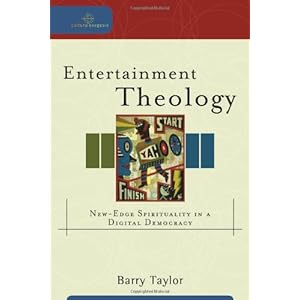
Entertainment Theology

Just finished Barry Taylor's Entertainment Theology: Exploring Spirituality in a Digital Democracy.  I liked it. 

In some ways a follow up to A Matrix of Meanings, his earlier collaboration with Craig Detweiler,  Entertainment Theology digs a little deeper into sociology and cultural theory as Taylor continues to affirm the value of popular culture as an arena for serious engagement with the postsecular spiritual search.  I particularly liked the treatment of the resurgence of interest in all things gothic - think Dan Brown, Buffy, Harry Potter, Donnie Darko.  This he reads as a manifestation of a desire positively to embrace the insecurity and uncertainty at the heart of postmodernity. 

Less satisfying was his reimagining of the role of Christian theology.   He believes that our era demands a move beyond Christianity as  Religion in order to fund the emergence of Christian Spiritualities.  Quite happy to explore this idea.  Trouble is Taylor has little of substance to say on this issue.  What we get instead are some (not unhelpful) pointers on methodology.  (Echoes here of the description of postliberalism as a clearing of the throat as a prelude to actually saying something.)   But maybe, hopefully, that's for the next book.  In the meantime this encouragement to plunge into the spate of popular yearning for more, trusting in the creative Spirit will do nicely.

Tuesday, 4 May 2010

Is God Still an Englishman?

The long train journey to and from Plymouth gave me time to read Cole Moreton's Is God Still an Englishman? How We Lost Our Faith (But Found New Soul)   

Moreton, a former Charismatic, former Alternative Worship type and now former Christian weaves together cultural commentary, autobiography and the occasional thread of sociology as he examines transformations in England, Englishness and in particular the religion, faith and spirituality of the English.  He does it in a highly readable way too.  Moreton visits John Wimber and the Death of Diana, The Nine O'Clock Service and Anti War Marches, Billy Graham and Greenham Common, Morris Cerullo and Jade Goody.  I see much of my story in his, the public events that have shaped his life touched mine also.  But even if you're not a middle-aged working class boy who converted to Christianity in his teens it's still well worth the nine hours or so it takes to read.

Like me you may not be quite as sanguine as Moreton about all the aspects of the rebranding and thinning of English religiosity but the author's own destination is not the point, what counts is the scenery he points out on route.  This is a non academic but well informed and convincing journalistic portrayal of the passing of English christendom and the ebbs and flows of secularisation.  Highly recommended.

Thursday, 17 December 2009

Postmodern Christian Spirituality


This is advanced notice of a module I'm helping to deliver here at Luther King House this summer.

We'll be looking at such areas as: spirituality and film; the turn from religion to spirituality; feminism and spirituality; spirituality and the novel; the state of contemporary charismatic spirituality.

The model is acutally part of the University of Manchester MA in Contextual Theology that we at The Partnership for Theological Education deliver but it is open for applications from people interested in the topic as a stand alone, non-assesed study opportunity.  Would be suitable for, among others, ministers taking study leave.

To find out more call the number above.

Tuesday, 17 November 2009

God in the Precinct 2


Prompted by a post over at revmusings to reflect on my recent offering on hearing God in the noise of the urban. Here's what I saw in the looking glass:

I'm not agin revmusing's suggestion that attending to God in silence helps to discern the divine tones amidst the noise of life. However, I reckon the key is being intentional, deliberately attending to what God may be saying in any given situation - wherever.

I'm developing one or two thoughts on what a noisy urban retreat might look like. I fancy the idea of taking The Bible into the melee and reading it in all manner of different places to see how that affects what we notice (in the word and in the world). So, for instance chewing over a psalm on the top deck of a bus or running through Mark in the market place or Timothy on the train station concourse. Then there's the idea of spending half-time next time I'm at Old Trafford praying rather than queuing for a pie. (Hang on, make that praying while queuing for a pie). Or what about sitting on a bench in the precinct meditating on the shop window ddisplays?

I reckon these are all worthwhile practices for each of us to pursue. I wonder though if it's worth organising a communal retreat along these signs (in Manchester, obviously) so that we can gather after our reading/praying/meditating and share what we've heard. Would there be any takers?

Thursday, 5 November 2009

God In The Precinct

My turn to do a month's worth of opinion pieces for the Baptist Times' "Outside Edge" column has come round again. With the agreement of the editor I'm posting my BT article here. To check out the Baptist Times as a whole click here.

The other Saturday I had a spiritual experience walking up Market Street. It was outside the Arndale centre, across from the baked potato vendor.

From the middle of nowhere came an adrenaline rush and a distinct Goddish whiff. Not this time a voice calling a new play for my life, more of an epiphany, a “Here I am” moment. And that “here” seemed to be the whole point of it. Here in the hustle, bustle and bump of shoppers; here in the noise of teenage girls screaming and giggling and a dirty-fingered version of Danny Boy played on an old busker’s tin whistle. Here between the conspiratorial knot of hooddies and the gloriously colourful African matriarch striding purposefully towards the number 86 bus. Bored-looking people were pressing promotional leaflets on reluctant rushers-by, HMV was graciously blessing us with Lilly Allen’s observations on life and God said, “Here I am. Right here.”

I must confess to being surprised. A bit like Ezekiel when God showed up by the Chebar Canal, rather than staying at home, safely tucked up in the temple. We’re not supposed to bump into God on city-centre shopping trips. We’re meant to head for the hills, retreat, go rural. Everyone knows that God prefers sheep to ghetto blasters and a misty dawn to neon light filtered through Manchester drizzle.

God speaks in silence, preferring not to shout above competing voices. God nudges you when you are still and empty-handed not while you are dashing about with an M and S shopping bag in one mit and a Gourmet Waffle in the other. God doesn’t like crowds, is allergic to noise, is happier in the countryside and just can’t get through to extroverts. That’s right isn’t it?

Well of course not. God is everywhere and clearly God loves the busy, energetic type as much as the introvert. Obviously. Or at least that’s how the theory goes. But check out the practice. Look where our retreat centres are – in a field, up a hill or by a babbling brook. Where are the backstreet poustinias? Who are the spiritual directors who hang out in Café Nero? Why cant’ I sign up for a noisy retreat?

I blame Wordsworth and his kind, you know, the Romantics who soft-focussed the wilderness and bequeathed us a pastoral idyll which the church has embraced as the spiritual equivalent of Escape to the Country. Although, come to think of it, wasn’t Wordsworth just as happy on Westminster Bridge as he was stomping over Borrowdale?

Not that I mind a bit of cloud-like lonely wandering myself from time to time. It’s just that God also insists on turning up in busy, concretey places. Like the moment I stepped out into a Time Square night after watching The Passion of the Christ and the whole place hummed with the love of God or like this Summer in the middle of the glam, the glitter and the tat of Lourdes when God said, something like, “I know this place is like a Skegness souvenir shop on Steroids, but just look at the faithful, hope-filled reaching out to me, look at the sheer colour of this churchy cross section of humanity - beautiful as oil in a puddle. I know this place is a bit RC for your taste, but I’m here, get used to it.”

Time, I think, for someone to develop spiritual guidance for city-dwellers. Time for more pricking up of the ears and glancing about for God in the urban. Time for people from Brecon to retreat to Bristol and for the Archers to go looking for God in Albert Square.