Spent most of the day planning and prepping for our upcoming summer school on Postmodern Spirituality.
I'm doing a session on spirituality and film which will look at a broad range of approaches to the spiritual in recent/contemporary film ranging from the explicitly religious (think Stigmata) thru to the more broadly aesthetic which might not be out and out spiritual but which nonetheless is concerned to see beyond the merely material to something other (think the paper bag blowing in the wind in American Beauty or Billy's Kestrel stilling the world in Kes).
As well as doing the analytical stuff I will also be showing a film on one of the evenings. Question is which film? It's not that I can't think of one but rather that I can't decide which. What would you you opt for? Remember what I'm looking at is not so much the out and out Christian God stuff but film as one of the media in which the spiritual questioning and questing of our age finds expression. Any ideas?
musings on mission and ministry ... and other miscellaneous mind-leaks
Showing posts with label Postmodernity. Show all posts
Showing posts with label Postmodernity. Show all posts
Wednesday, 2 June 2010


Monday, 31 May 2010
Entertainment Theology
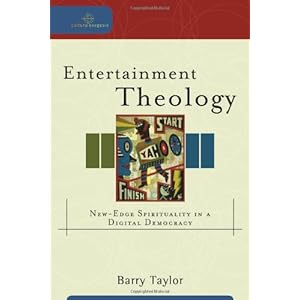
In some ways a follow up to A Matrix of Meanings, his earlier collaboration with Craig Detweiler, Entertainment Theology digs a little deeper into sociology and cultural theory as Taylor continues to affirm the value of popular culture as an arena for serious engagement with the postsecular spiritual search. I particularly liked the treatment of the resurgence of interest in all things gothic - think Dan Brown, Buffy, Harry Potter, Donnie Darko. This he reads as a manifestation of a desire positively to embrace the insecurity and uncertainty at the heart of postmodernity.
Less satisfying was his reimagining of the role of Christian theology. He believes that our era demands a move beyond Christianity as Religion in order to fund the emergence of Christian Spiritualities. Quite happy to explore this idea. Trouble is Taylor has little of substance to say on this issue. What we get instead are some (not unhelpful) pointers on methodology. (Echoes here of the description of postliberalism as a clearing of the throat as a prelude to actually saying something.) But maybe, hopefully, that's for the next book. In the meantime this encouragement to plunge into the spate of popular yearning for more, trusting in the creative Spirit will do nicely.
Thursday, 17 December 2009
Postmodern Christian Spirituality

This is advanced notice of a module I'm helping to deliver here at Luther King House this summer.
We'll be looking at such areas as: spirituality and film; the turn from religion to spirituality; feminism and spirituality; spirituality and the novel; the state of contemporary charismatic spirituality.
The model is acutally part of the University of Manchester MA in Contextual Theology that we at The Partnership for Theological Education deliver but it is open for applications from people interested in the topic as a stand alone, non-assesed study opportunity. Would be suitable for, among others, ministers taking study leave.
To find out more call the number above.
Wednesday, 1 April 2009
Summer School Part Two: The Bible in Post Modern Context
 Further to my earlier post on our Partnership For Theological Education Summer School here in Manchester on religious diversity, we can now release details of the other strand that will be running concurrently. Mark Brummit is a highly engaging and somewhat unconventional teacher. Formerly research fellow in biblical studies here at LKH he is currently assistant prof at Colgate College, Rochester, NY.
Wednesday, 21 January 2009
Blah ... Manchester Pete Ward

For those who might be interested but haven't picked them up elsewhere here's the details of the next Blah ... Manchester event. Pete Ward will be at the Nazarene College to speak on Participation and Meditation: A Practical Theology for the Liquid Church. How do we encounter God through Culture? Is liquid Church just an abstract academic ideal?
Wednesday, 3 December 2008
Olive and John Drane
The Dranes are blogging. They are calling it 2churchmice's Blog Yeah, sounds a bit twee to me too. Still, should be worth checking out from time to time.
Thursday, 30 October 2008
Church As Argument
 Just got my new copy of Bryan Stone's excellent Evangelism After Christendom. (See the
"Stuff I reccomend" panel on the right.) Had to buy a new copy as I seem to have lost or loaned out my old one. It's been missing now for a few months. I was hoping it would turn up as it has lots of lovely scribblings and underlinings in, but no joy. Frustrating not to have access to my original reactions but I'm going to enjoy rereading it.
Opening the new package from amazon reminded me that Stone's discussion of being an evangelistic church in a pluralistic, post-modern society includes reference to Kathryn Tanner's observation in her Theories of Culture: a new agenda for theology that Christian identity is constituted "by a community of argument concerning the meaning of true discipleship."
That struck me at the time as a very helpful way to conceive of the church. The thought has stuck with me, and grown on me. Here's why I like it:
- It's realistic about the divergence of opinions and interpretations within the church.
- It takes a centered set approach to church rather than a bounded set approach.
- It speaks of commitment and conviction - without these you wouldn't bother arguing.
- It implies a notion of church as a process extended through space and time with all the continuities and discontinuities that implies.
- It takes seriously the notion that not only does the church have to relate to wider culture but is also itself a culture in its own right.
Friday, 4 January 2008
Sooo Not Dead
This is the last of my three posts arising from comments on the poll relating to conservatives/evangelicals, liberals/radicals and evangelism.
I have to confess that some of the comments irked me. Let me respond first of all to Graham and Tim’s observations.
Graham expressed surprise that anyone still used the labels in question and Tim was of the opinion that the terms were “so twentieth century” and tells us that he is in the habit of “ignoring people who use such labels.”
I am tempted to ask if Graham and Tim are living so much on the cutting edge of the brave new postmodern world that they have lost touch with the world as it actually is. They may well want to get beyond the era of evangelicals and liberals but I have to tell them we certainly ain’t there yet.
Taking evangelicals as an example (the movement I know most about), if Tim is to continue ignoring people who wear that particular label he’s probably going to end up shutting his eyes to the church of the future. As Philip Jenkins points out in his top notch The Next Christendom it looks exceedingly likely that the future of world Christianity will be southern (hemisphere), conservative/evangelical and pentecostal. Already in this country, if it wasn’t for those churches which choose to identify themselves as evangelical, the church attendance stats would be even more depressing. (See for example Peter Brierley’s observations on the 2005 English Church Census in his
Pulling Out of the Nosedive.)
We may feel that evangelicalism and liberalism are such thoroughgoing modernist expressions of the faith that they are ultimately doomed. Maybe. But don’t underestimate just how long modernity will be with us. Don’t underestimate the number of people in the church who for good or ill find the certainties of modernity (whether rationalistic certainties or fideistic certainties) a very attractive refuge from the shifting sands of the post. And don’t overestimate the proportion of Christians who have embraced the move away from the old and admittedly creaking categories. (I suspect the fifty fifty split in this weeks poll result is a long way from being representative of the church at large. You are a weird bunch.) We mustn’t project our desires for how we would like it to be onto the way it actually is.
As for describing the labels as “so twentieth century” that’s just sooooo pretentious.
Jodie’s observation got under my skin for different reasons. It is worryingly sweeping and dismissive. Let me quote his comment in full:
“Yes conservative/evangelical Christians are great at getting people to leave their brains at the door, recite a formulaic prayer and provide little evidence of extending God's amazing grace to the least. Well done!”
Now, to a certain extent, this is a fair description and a justifiable criticism of evangelical attempts at disciple-making … but only if we are talking about evangelicalism at its worst. At its best, and even at a fair bit less than its best, evangelicalism has had a far more positive impact for the kingdom than Jodie suggests.
The revivals of the 18C did make a significant and welcome if relatively short-lived difference. Some of the social/political reforms and hands on social action of the 19C evangelicals (such as Wilberforce and Booth) ought not to be set on one side so easily. More recently the likes of Rene Padilla and other Latin American evangelicals who were influenced by liberation theology have played a key part in helping western evangelicalism to shift back towards a more holistic understanding and expression of the gospel.
I admit that in many ways contemporary evangelicalism is ripe for criticism. (Indeed I’ve spent a fair bit of time in recent years having a go myself – and will no doubt continue to do so in the future.) But this is precisely why we need to be careful. It would be so easy to turn this vigorous, varied and influential (if deeply flawed) movement into an all too easy whipping boy. ASBO Jesus is good for a laugh but it is only a cartoon. We are experts in the church at overreacting to our recent failings by running so hard in the opposite direction that we fail to carry the strengths of our recent past with us.
There’s no doubt that evangelicalism as a movement is undergoing huge changes. There’s no doubt that the meaning of the term is shifting in all sorts of ways. It is certainly filling out. At least in the evangelical academy it is adding a more substantial theology of creation to its traditional crucicentrism; adding an appreciation of more contemplative spiritualities to its traditional activism; embracing notions of journey in ways that substantially modify its traditional conversionism and becoming more diverse in the way it expresses its traditional Biblicism. Will these trends filter down into evangelicalism on the ground? I hope so. Will the term become so extensively modified and stretched as to cease to be of use? Possibly. Will it find a recognisable home beyond the predicted demise of modernity? Let’s see. But whatever is happening, whatever will happen, whatever I would like to see happen, whatever Tim, Graham and Jodie think is happening I’m pretty sure it’s far too soon just yet to be writing obituaries.

I have to confess that some of the comments irked me. Let me respond first of all to Graham and Tim’s observations.
Graham expressed surprise that anyone still used the labels in question and Tim was of the opinion that the terms were “so twentieth century” and tells us that he is in the habit of “ignoring people who use such labels.”
I am tempted to ask if Graham and Tim are living so much on the cutting edge of the brave new postmodern world that they have lost touch with the world as it actually is. They may well want to get beyond the era of evangelicals and liberals but I have to tell them we certainly ain’t there yet.
Taking evangelicals as an example (the movement I know most about), if Tim is to continue ignoring people who wear that particular label he’s probably going to end up shutting his eyes to the church of the future. As Philip Jenkins points out in his top notch The Next Christendom it looks exceedingly likely that the future of world Christianity will be southern (hemisphere), conservative/evangelical and pentecostal. Already in this country, if it wasn’t for those churches which choose to identify themselves as evangelical, the church attendance stats would be even more depressing. (See for example Peter Brierley’s observations on the 2005 English Church Census in his
Pulling Out of the Nosedive.)
We may feel that evangelicalism and liberalism are such thoroughgoing modernist expressions of the faith that they are ultimately doomed. Maybe. But don’t underestimate just how long modernity will be with us. Don’t underestimate the number of people in the church who for good or ill find the certainties of modernity (whether rationalistic certainties or fideistic certainties) a very attractive refuge from the shifting sands of the post. And don’t overestimate the proportion of Christians who have embraced the move away from the old and admittedly creaking categories. (I suspect the fifty fifty split in this weeks poll result is a long way from being representative of the church at large. You are a weird bunch.) We mustn’t project our desires for how we would like it to be onto the way it actually is.
As for describing the labels as “so twentieth century” that’s just sooooo pretentious.
Jodie’s observation got under my skin for different reasons. It is worryingly sweeping and dismissive. Let me quote his comment in full:
“Yes conservative/evangelical Christians are great at getting people to leave their brains at the door, recite a formulaic prayer and provide little evidence of extending God's amazing grace to the least. Well done!”
Now, to a certain extent, this is a fair description and a justifiable criticism of evangelical attempts at disciple-making … but only if we are talking about evangelicalism at its worst. At its best, and even at a fair bit less than its best, evangelicalism has had a far more positive impact for the kingdom than Jodie suggests.
The revivals of the 18C did make a significant and welcome if relatively short-lived difference. Some of the social/political reforms and hands on social action of the 19C evangelicals (such as Wilberforce and Booth) ought not to be set on one side so easily. More recently the likes of Rene Padilla and other Latin American evangelicals who were influenced by liberation theology have played a key part in helping western evangelicalism to shift back towards a more holistic understanding and expression of the gospel.
I admit that in many ways contemporary evangelicalism is ripe for criticism. (Indeed I’ve spent a fair bit of time in recent years having a go myself – and will no doubt continue to do so in the future.) But this is precisely why we need to be careful. It would be so easy to turn this vigorous, varied and influential (if deeply flawed) movement into an all too easy whipping boy. ASBO Jesus is good for a laugh but it is only a cartoon. We are experts in the church at overreacting to our recent failings by running so hard in the opposite direction that we fail to carry the strengths of our recent past with us.
There’s no doubt that evangelicalism as a movement is undergoing huge changes. There’s no doubt that the meaning of the term is shifting in all sorts of ways. It is certainly filling out. At least in the evangelical academy it is adding a more substantial theology of creation to its traditional crucicentrism; adding an appreciation of more contemplative spiritualities to its traditional activism; embracing notions of journey in ways that substantially modify its traditional conversionism and becoming more diverse in the way it expresses its traditional Biblicism. Will these trends filter down into evangelicalism on the ground? I hope so. Will the term become so extensively modified and stretched as to cease to be of use? Possibly. Will it find a recognisable home beyond the predicted demise of modernity? Let’s see. But whatever is happening, whatever will happen, whatever I would like to see happen, whatever Tim, Graham and Jodie think is happening I’m pretty sure it’s far too soon just yet to be writing obituaries.
Friday, 28 December 2007
If The Label Sticks, Wear It!
 clipped from www.flickr.com clipped from www.flickr.com |

Certainly a young friend of mine recently insisted that his mates just didn’t like labels and would prefer not to be labeled by others or to apply them to themselves. Guess that makes them anti-labelists!
Whatever the pros and cons of labels I’m not sure we can or indeed should live without them. I do however sympathise with my friend to a certain extent. Labels can be used in ways that are very unhelpful.
It’s not good to fly labels like colours behind which we ride into battle against others with different labels.
It’s not good to use labels to limit, tie down and dismiss others.
It’s not good to use labels flatten difference, obscure the peculiar and oversimplify reality.
Antipathy towards labeling is part of the postmodern turn. According to Zygmunt Baumann’s excellent Modernity and Ambilvelance a certain approach to labeling is deeply characteristic of modernity's obsession with classifying all of reality and its deep unease with the ambivalent. The postmodern critique is to be welcomed, reality is not susceptible to neat, Dewi-decimal-type classification and we do violence to reality, including the reality of people and their bodies, when we insist on fitting everything into our predetermined categories. But we needn’t use labels in such a way and I reckon we can’t and shouldn’t live without labels at all.
We need labels to denote collectives who share common characteristics, commitments, convictions and associations.
They also come in handy to locate people.
And those who would deny our need for labels are surely also in denial of the inescapable and indeed immensely valuable corporate dimension of human identity.
So I vote for labels, I thank God for labels, labels help give clarity to my identity. As long that is you don’t use my labels for the negative purposes outlined above and as long you recognise that labels are not fixed but fluid and living, with meanings on the move, then I really don’t mind, go ahead, label me.
Subscribe to:
Posts (Atom)